

/ EN
Technical Support
| Contact Us
+1 312-802-6843
Technical Support
Contact Us
+1 312-802-6843
/ EN
Recover password
Professional Email
Verification Code
Send Code
Password
Anti-ACAA2 Rabbit pAb
Catalog Number: PTM-6906
$ 280

Clone Number: /

Host: Rabbit Clonality: Polyclonal

Applications: WB IHC-P

Reactivity: Human, Mouse

Synonyms: Mitochondrial 3-ketoacyl-CoA thiolase, Acetyl-CoA acetyltransferase, Acetyl-CoA acyltransferase, mitochondrial Acyl-CoA hydrolase, beta-ketothiolase, Mitochondrial 3-oxoacyl-CoA thiolase, T1

Product Size
100 μl
Quantity

Shipping: Ambient temperature

Order online or send purchase order to info@ptmbio.com

FAQ Technical Support Protocols

General Information
Isotype IgG
Conjugate Unconjugated
Synonyms Mitochondrial 3-ketoacyl-CoA thiolase, Acetyl-CoA acetyltransferase, Acetyl-CoA acyltransferase, mitochondrial Acyl-CoA hydrolase, beta-ketothiolase, Mitochondrial 3-oxoacyl-CoA thiolase, T1
UniProt ID

P42765

Immunogen Synthetic peptide derived from human mitochondrial 3-ketoacyl-CoA thiolase
MW (kDa) 42
Specificity
Product Usage Information
Applications Dilution Recommended Species
WB 1:1000 Human, Mouse
IHC-P 1:200 - 1:1000 Human
Properties
Purity Protein A and immunogen affinity purified
Constituents PBS, Glycerol, BSA
Storage Store at -20°C. Avoid freeze/thaw cycles.
Stability Stable for 12 months from date of receipt/reconstitution.
Target Information

Background

In the production of energy from fats, acetyl-Coenzyme A acyltransferase 2 (ACAA2) is one of the enzymes that catalyzes the last step of the mitochondrial beta-oxidation pathway, an aerobic process breaking down fatty acids into acetyl-CoA. Using free CoA, ACAA2 catalyzes the thiolytic cleavage of medium- to long-chain unbranched 3-oxoacyl-CoAs into acetyl-CoA and a fatty acyl-CoA shortened by two carbon atoms. ACAA2 also catalyzes the condensation of two acetyl-CoA molecules into acetoacetyl-CoA and could be involved in the production of ketone bodies. ACAA2 also displays hydrolase activity on various fatty acyl-CoAs. Thereby, could be responsible for the production of acetate in a side reaction to beta-oxidation.

Cellular location

Mitochondrion

Images
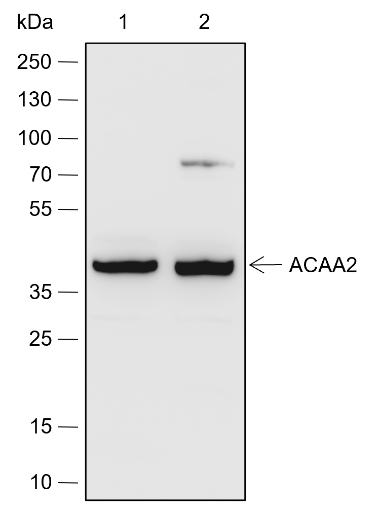
WB

Blocking buffer: 5% NFDM/TBST
Primary Ab dilution: 1:1000
Primary Ab incubation: 2 hours at room temperature
Secondary Ab: Goat Anti-Rabbit IgGH&L (HRP Conjugate)
Lysate: 1: HepG2, 2: HeLa
Protein loading quantity: 20 μg
Exposure time: 10 seconds
Predicted band size: 42 kDa
Observed band size: 42 kDa

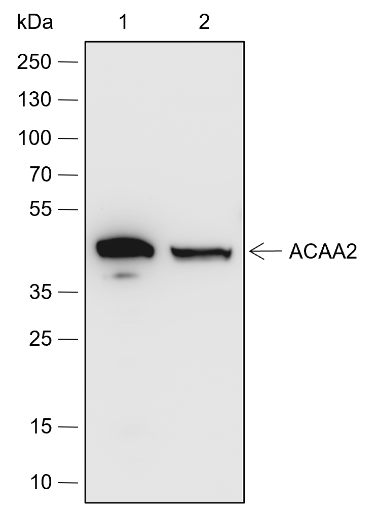
Blocking buffer: 5% NFDM/TBST
Primary Ab dilution: 1:1000
Primary Ab incubation: 2 hours at room temperature
Secondary Ab: Goat Anti-Rabbit IgGH&L (HRP Conjugate)
Lysate: 1: Human liver, 2: Mouse liver
Protein loading quantity: 20 μg
Exposure time: 30 seconds
Predicted band size: 42 kDa
Observed band size: 42 kDa

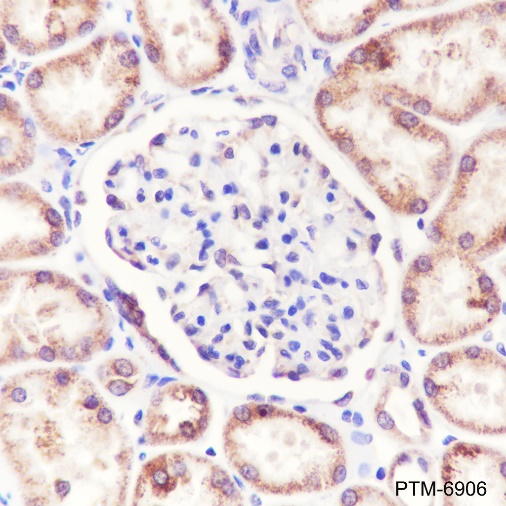
IHC-P

Tissue: Human kidney
Section type: Formalin-fixed & Paraffin-embedded section
Retrieval method: High temperature and high pressure
Retrieval buffer: Tris/EDTA buffer, pH9.0
Primary Ab dilution: 1:1000
Primary Ab incubation: 1 hour at room temperature
Secondary Ab: Anti-Rabbit and Mouse Polymer HRP (Ready to Use)
Counter stain: Hematoxylin (Blue)
Description: The brown color represents the positive signal observed with PTM-6906

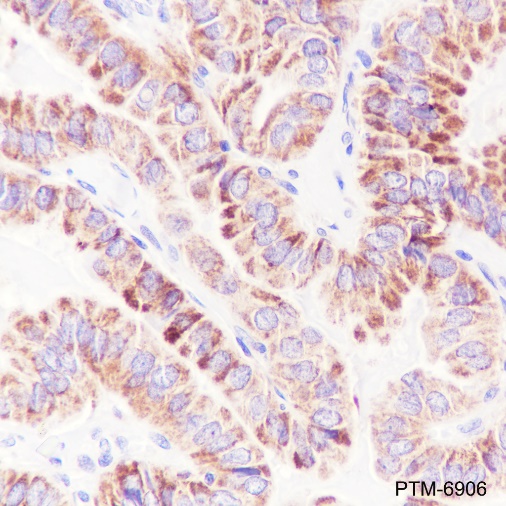
Tissue: Human thyroid carcinoma
Section type: Formalin-fixed & Paraffin-embedded section
Retrieval method: High temperature and high pressure
Retrieval buffer: Tris/EDTA buffer, pH9.0
Primary Ab dilution: 1:1000
Primary Ab incubation: 1 hour at room temperature
Secondary Ab: Anti-Rabbit and Mouse Polymer HRP (Ready to Use)
Counter stain: Hematoxylin (Blue)
Description: The brown color represents the positive signal observed with PTM-6906

Research Use

For research use only, not for use in diagnostic procedures.