

/ EN
Technical Support
| Contact Us
+1 312-802-6843
Technical Support
Contact Us
+1 312-802-6843
/ EN
Recover password
Professional Email
Verification Code
Send Code
Password
Recombinant
Anti-PCK1 Mouse mAb
Catalog Number: PTM-5939
$ 285

Clone Number: 10242

Host: Mouse Clonality: Recombinant Monoclonal

Applications: WB IHC-P

Reactivity: Human, Rat

Synonyms: Phosphoenolpyruvate carboxykinase cytosolic [GTP], PEPCK-C, Serine-protein kinase PCK1, PEPCK1

Product Size
100 μl
Quantity

Shipping: Ambient temperature

Order online or send purchase order to info@ptmbio.com

FAQ Technical Support Protocols

General Information
Isotype IgG1
Conjugate Unconjugated
Synonyms Phosphoenolpyruvate carboxykinase cytosolic [GTP], PEPCK-C, Serine-protein kinase PCK1, PEPCK1
UniProt ID

P35558

Immunogen Synthetic peptide derived from human PCK1
MW (kDa) 65
Specificity
Product Usage Information
Applications Dilution Recommended Species
WB 1:500 - 1:1000 Human, Rat
IHC-P 1:50 - 1:100 Human, Rat
Properties
Purity Protein G purified
Constituents PBS, Glycerol, BSA
Storage Store at -20°C. Avoid freeze/thaw cycles.
Stability Stable for 12 months from date of receipt/reconstitution.
Target Information

Background

Cytosolic phosphoenolpyruvate carboxykinase that catalyzes the reversible decarboxylation and phosphorylation of oxaloacetate (OAA) and acts as the rate-limiting enzyme in gluconeogenesis. Regulates cataplerosis and anaplerosis, the processes that control the levels of metabolic intermediates in the citric acid cycle. At low glucose levels, it catalyzes the cataplerotic conversion of oxaloacetate to phosphoenolpyruvate (PEP), the rate-limiting step in the metabolic pathway that produces glucose from lactate and other precursors derived from the citric acid cycle. At high glucose levels, it catalyzes the anaplerotic conversion of phosphoenolpyruvate to oxaloacetate. Acts as a regulator of formation and maintenance of memory CD8(+) T-cells: up-regulated in these cells, where it generates phosphoenolpyruvate, via gluconeogenesis (By similarity). The resultant phosphoenolpyruvate flows to glycogen and pentose phosphate pathway, which is essential for memory CD8(+) T-cells homeostasis.

Cellular location

Cytoplasm, Endoplasmic reticulum

Images
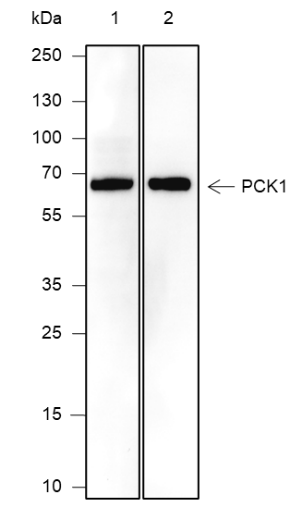
WB

Blocking buffer: 5% NFDM/TBST
Primary Ab dilution: 1:1000
Primary Ab incubation: room temperature 2h
Secondary Ab: Goat Anti-Mouse IgG H&L pAb (HRP Conjugate)
Lysate: 1: Human liver, 2: Rat kidney
Protein loading quantity: 20 μg
Exposure time: 60 s
Predicted MW: 65 kDa
Observed MW: 65 kDa

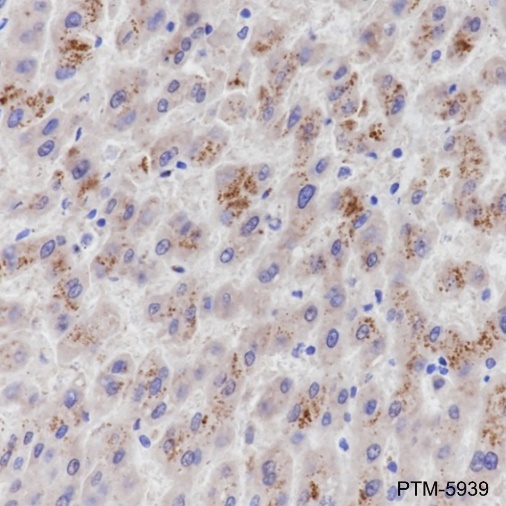
IHC-P

Tissue: Human liver
Section type: Formalin fixed & Paraffin -embedded section
Retrieval method: High temperature and high pressure
Retrieval buffer: Tris/EDTA buffer, pH 9.0
Primary Ab dilution: 1:100
Primary Ab incubation: 1 hour at room temperature
Secondary Ab: Anti-Rabbit and Mouse Polymer HRP (Ready to Use)
Counter stain: Hematoxylin (Blue)
Description: The brown color represents the positive signal observed with PTM-5939

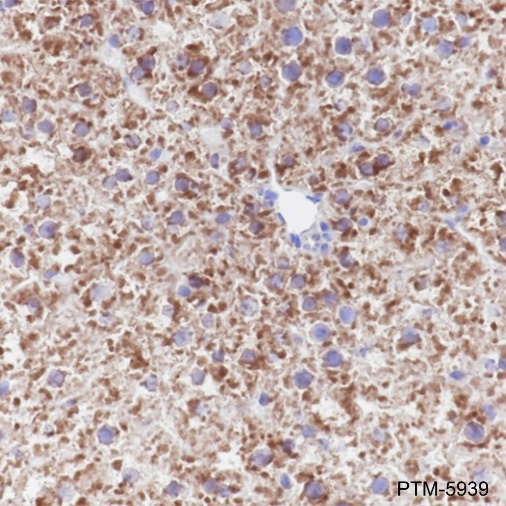
Tissue: Rat liver
Section type: Formalin fixed & Paraffin -embedded section
Retrieval method: High temperature and high pressure
Retrieval buffer: Tris/EDTA buffer, pH 9.0
Primary Ab dilution: 1:100
Primary Ab incubation: 1 hour at room temperature
Secondary Ab: Anti-Rabbit and Mouse Polymer HRP (Ready to Use)
Counter stain: Hematoxylin (Blue)
Description: The brown color represents the positive signal observed with PTM-5939

Research Use

For research use only, not for use in diagnostic procedures.

References (1)
  • Dysregulation of argininosuccinate synthase 1, phosphoenolpyruvate carboxykinase 1, and carbonyl reductase 3: Key arginine–proline metabolic mediators in mesangioproliferative glomerulopathies
    Year 2025
    Journal INTERNATIONAL JOURNAL OF BIOLOGICAL MACROMOLECULES
    Authors Jiayi He, et al.
    Applications Unspecified
    Reactivity