

/ EN
Technical Support
| Contact Us
+1 312-802-6843
Technical Support
Contact Us
+1 312-802-6843
/ EN
Recover password
Professional Email
Verification Code
Send Code
Password
Recombinant Rabbit Monoclonal
Anti-Phospho-c-Myc (Ser62) Rabbit mAb
Catalog Number: PTM-6921
$ 310

Clone Number: JMMR-3054

Host: Rabbit Clonality: Recombinant Monoclonal

Applications: WB

Reactivity: Human

Synonyms: Myc proto-oncogene protein, Class E basic helix-loop-helix protein 39 (bHLHe39), Proto-oncogene c-Myc, Transcription factor p64, MYC, BHLHE39, MYCpS62

Product Size
100 μl
Quantity

Shipping: Ambient temperature

Order online or send purchase order to info@ptmbio.com

FAQ Technical Support Protocols

General Information
Isotype IgG
Conjugate Unconjugated
Synonyms Myc proto-oncogene protein, Class E basic helix-loop-helix protein 39 (bHLHe39), Proto-oncogene c-Myc, Transcription factor p64, MYC, BHLHE39, MYCpS62
UniProt ID

P01106

Immunogen Phosphorylated human c-Myc (Ser62) peptide
MW (kDa) 49
Specificity
Product Usage Information
Applications Dilution Recommended Species
WB 1:1000 Human
Properties
Purity Protein A purified
Constituents PBS, Glycerol, BSA
Storage Store at -20°C. Avoid freeze/thaw cycles.
Stability Stable for 12 months from date of receipt/reconstitution.
Target Information

Background

Myc, also known as c-Myc, together with l-Myc and n-Myc, belongs to the Myc family of transcription factors. Myc has a basic helix-loop-helix leucine zipper domain and through heterodimerization can bind and regulate the transcriptional activity of genes. It is a key player in the regulation of cell growth and cell cycle progression and acts as a proto-oncogene. Myc localizes to the nucleus but can also be present in the cytoplasm of certain cancer types. Myc is ubiquitously expressed in almost all cell types and its expression positively correlates with tissue proliferative capacity. Myc is also expressed during embryogenesis. Myc is upregulated in many cancer types, especially in aggressive, poorly differentiated tumors. Mutations in the MYC gene and breakpoint translocations within the MYC gene cause Burkitt lymphoma. In addition, Myc is subject to various post-translational modifications, including phosphorylation, acetylation, and ubiquitinylation.

Cellular location

Nucleus
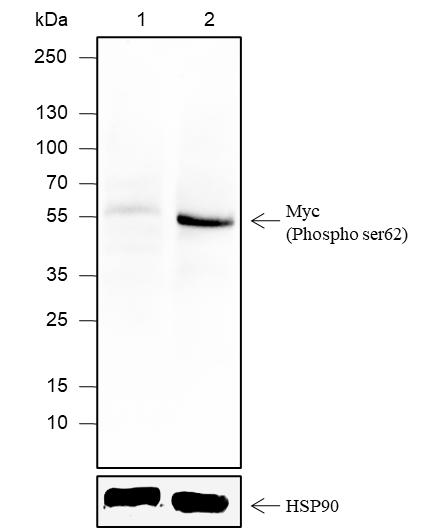
Images
WB

Blocking buffer: 5% NFDM/TBST
Primary Ab dilution: 1:1000
Primary Ab incubation: 2 hours at room temperature
Secondary Ab: Goat Anti-Rabbit IgGH&L (HRP Conjugate)
Lysate: 1: (-) HCT-116; 2: (+) HCT-116+MG-132
Protein loading quantity: 20 μg
Exposure time: 60 seconds
Predicted band size: 49 kDa
Observed band size: 55 kDa

Research Use

For research use only, not for use in diagnostic procedures.

Recommended Products
  • View More Images(1)
    $ 280
    Recombinant
    Anti-c-Myc Mouse mAb
    Catalog #
    PTM-5143
    Host
    Mouse
    Clonality
    Recombinant Monoclonal
    Conjugate
    Unconjugated
    Reactivity
    All
    Applications:
    WB IHC-P ICC/IF FC IAP IP ChIP mIHC-P CUT&Tag