
/ EN
Technical Support
| Contact Us
+1 312-802-6843
Technical Support
Contact Us
+1 312-802-6843
/ EN
Recover password
Professional Email
Verification Code
Send Code
Password
Recombinant Rabbit Monoclonal
Anti-Acetyl-Histone H2B (Lys5) Mouse mAb-BSA and Azide free
Catalog Number: PTM-152F
$ 480

Clone Number: /

Host: Mouse Clonality: Monoclonal

Applications: WB IHC-P IP ChIP

Reactivity: Human, Mouse, Rat

Synonyms: H2BK5ac

Product Size
100μg

Shipping: Ambient temperature

Order online or send purchase order to info@ptmbio.com

FAQ Technical Support Protocols

General Information
Isotype IgG
Conjugate Unconjugated
Synonyms H2BK5ac
UniProt ID

P62807

Immunogen Acetylated human histone H2B (Lys5) peptide
MW (kDa) 14
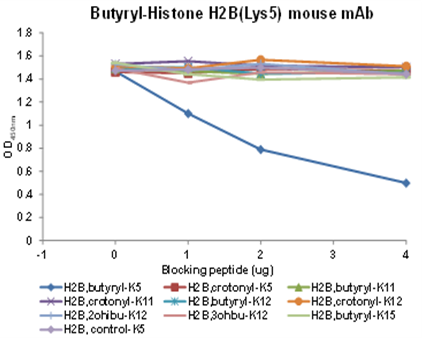
Specificity Anti-Acetyl-Histone H2B (Lys5) Mouse mAb detects histone H2B only when it is acetylated at Lys5.
Product Usage Information
Applications Dilution Recommended Species
WB 1:500 - 1:2000 Human, Mouse, Rat
IHC-P 1:200 - 1:1000 Human
IP 1:25 Human
ChIP 1:50 Human
Properties
Purity Protein G and immunogen affinity purified
Constituents PBS
Storage Centrifuge the vial at 12,000 x g for 20 seconds before reconstitution. Add 100 μL of sterile deionized water to achieve a final antibody concentration of 1 mg/ml. After reconstitution, the antibody will be in 1X PBS. Aliquot and store at -80°C, and avoid freeze/thaw cycles.
Stability Stable for 12 months from date of receipt/reconstitution.
Target Information

Background

Histone post-translational modifications (PTMs), known as the “histone code”, are key mechanisms of epigenetics that modulate chromatin structures. The PTMs on histone including acetylation, methylation, phosphorylation, and novel acylations directly affect the accessibility of chromatin to transcription factors and other epigenetic regulators, altering genome stability and gene transcription. Histone acetylation, tightly controlled by the opposing action of histone acetyltransferases (HATs) and histone deacetylases (HDACs), occurs primarily at lysine residues on the N-terminal tails of histones H2A (Lys5, 9, and 15), H2B (Lys5, 12, 15, 16, and 20), H3 (Lys4, 9, 14, 18, 23, 27, and 36), and H4 (Lys5, 8, 12, 16, and 20), and plays vital roles in the regulation of gene expression, DNA damage repair, chromatin dynamics, etc.

Cellular location

Nucleus
Images
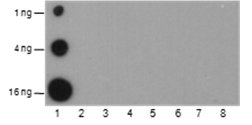
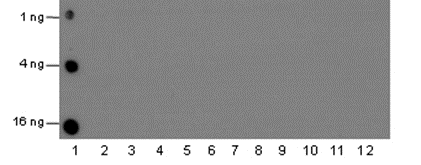
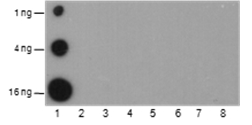
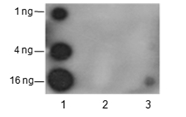
Dot Blot

Blocking buffer: 5% NFDM/TBST
Primary Ab dilution: 1: 1000
Primary Ab incubation condition: 2 hours at room temperature
Secondary Ab: Goat Anti-Mouse IgG H&L (HRP)
Peptide amount: 1 ng, 4 ng, 16 ng
Exposure time: 60 s
The list of peptides is included in the table below:
Lane 1: H2BK5ac;Lane 2: H2BK5bu ;
Lane 3: H2BK5hib ;Lane 4: H2BK5bhb ;
Lane 5: H2BK5cr ; Lane 6: H2BK11bhb ;
Lane 7: H2BK11cr ; Lane 8: H2BK5un ;

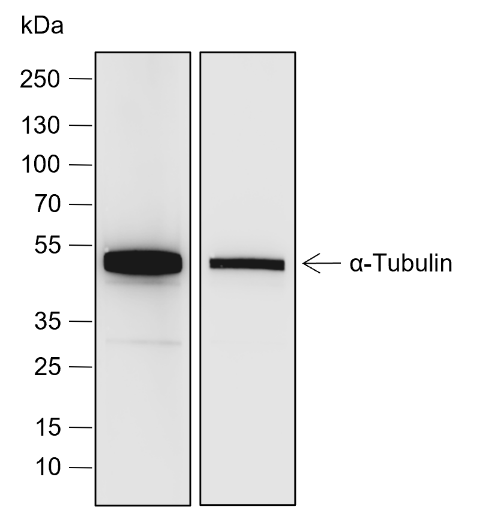
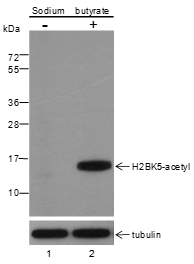
WB

Blocking buffer: 5% NFDM/TBST
Primary Ab dilution: 1:2000
Primary Ab incubation condition: 2 hours at room temperature
Secondary Ab: Goat Anti-Mouse IgG H&L (HRP)
Lysate: (-) HeLa, (+) HeLa+Sodium butyrate (30mM, 4hr)
Protein loading amount: 20 μg
Exposure time: 60 s
Predicted MW: 14 kDa
Observed MW: 14 kDa

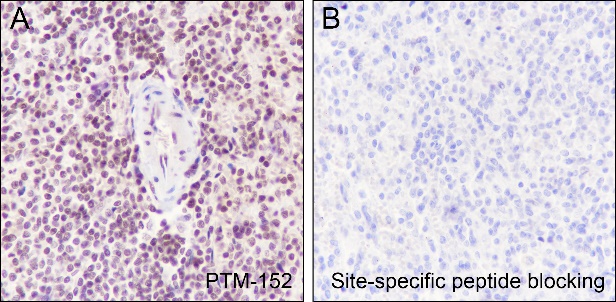
IHC-P

Tissue: Human spleen
Section type: Formalin-fixed & paraffin-embedded section
Retrieval method: High temperature and high pressure
Retrieval buffer: Tris/EDTA buffer, pH 9.0
Primary Ab dilution: 1:1000
Primary Ab incubation condition: 1 hour at room temperature
Secondary Ab: Anti-Rabbit and Mouse Polymer HRP (Ready to use)
Counter stain: Hematoxylin (Blue)
Comment: Color brown is the positive signal for PTM- 152F

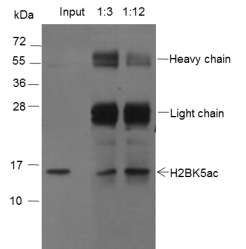
IP

IP of HeLa+Sodium butyrate (30mM, 4hr) cells extracts
IP Ab incubation condition: PTM-152F, 4°C overnight, 1:3, 1:12 dilution
WB primary Ab incubation condition: PTM- 107, room temperature 2h, 1: 2000 dilution
Secondary Ab: Anti-Rabbit IgG for IP (HRP)
Blocking buffer: 5% NFDM/TBST
Dilution buffer: 5% NFDM/TBST
1: 5% Input
2: IP with PTM-152F (1:3)
3: IP with PTM- PTM-152F (1:12)
Observed MW: 14 kDa
Exposure time: 60 s

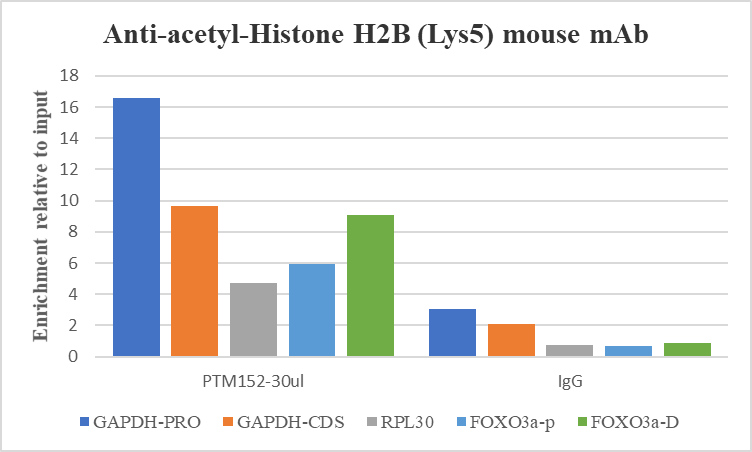
ChIP

Cell type: HeLa+Serum starvation (12h) +SBA (5mM, 24h)
Cross-linking conditions: No cross-linking
Amount of chromatin per IP: 5×10⁶ cells
Amount of Ab per IP: 1:50
Beads type and amount per IP: 50 μl of Protein A/G MagBeads
Comment: The ChIP was performed with 1 μg of normal rabbit IgG as a negative control. Real time quantitative PCR was performed on immunoprecipitated DNA using primers specific for the human GAPDH Promoter, GAPDH CDS region, RPL30, FOXO3a-promoter and FOXO3a-downstream. Data are presented as enrichment of each sample relative to total amount of input chromatin at each amplicon.

Research Use

For research use only, not for use in diagnostic procedures.