



Background
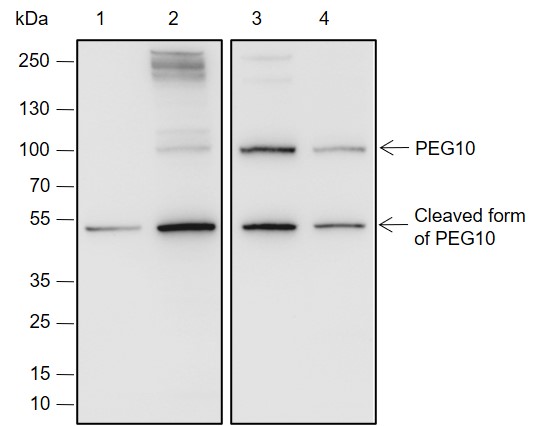
Paternally expressed gene 10(PEG10 ) is an imprinted gene which is derived from a Ty3/Gypsy long terminal repeat (LTR) retrotransposon family encoding Gag- and Pol-like domains. Deletion of PEG10 in mice leads to embryonic lethality due to defects in placental formation. PEG10 is aberrantly expressed in several cancer types, including hepatocellular carcinoma, and contributes to tumorigenesis by affecting cell proliferation, apoptosis, and metastasis. The PEG10 gene has two overlapping open reading frames that are regulated by the programmed process of -1 frameshifting. The first encoded protein ORF1 (or RF1) has a Gag domain with coiled-coil domain and zinc finger domains, while ORF1-2 (or RF1/RF2) is produced by -1 frameshifting and creates a fusion of the ORF1 Gag domain with a carboxyl-terminal Pol-like protease domain. PEG10 has retained the ability to form virus-like particles (VLPs) that are secreted as small extracellular vesicles delivered to distant sites.
Cellular location
Cytoplasm, Cell membrane, Nucleus