



Interested in our services
Contact our experts to provide further information




Lactylation (Kla) is a newly discovered protein post-translational modification driven by lactate. First identified by the team led by Prof. Yingming Zhao at the University of Chicago, lactylation has been shown to play key regulatory roles in tumor progression, immune inflammation, cardiovascular diseases, neurological disorders, and other pathological processes.
In 2024, in collaboration with PTM BIO, the research team successfully distinguished and characterized three lactylation-related isomeric modifications: L-lactylation (KL-la), D-lactylation (KD-la), and ce-lactylation (Kce).
L-lactylation is the earliest discovered and most extensively studied type of lactylation. Evidence suggests that L-lactylation is a major responder to glycolysis and the Warburg effect in eukaryotes. It is widely distributed across multiple tissues and organs and plays important roles in cancer, cardiovascular diseases, neurological disorders, and digestive system diseases.
As a leader in lactylation research, PTM BIO provides comprehensive L-lactylation and D-lactylation PTMomics analysis services. Powered by highly specific proprietary L-/D-lactylation antibodies and quantitative proteomics technology, PTM BIO enables specific discrimination and identification of L-lactylation and D-lactylation, helping researchers uncover their distinct biological functions and molecular mechanisms. This provides more precise insights into medical questions related to cancer, immunity, and other disease areas.
Protein samples are first enzymatically digested into peptide mixtures. The modified peptides are then enriched using PTM BIO’s proprietary L-lactylation antibodies and optimized enrichment materials, enabling specific recognition and enrichment of L-lactylated peptides.
Finally, the enriched peptides are analyzed and quantified by liquid chromatography–tandem mass spectrometry (LC-MS/MS).
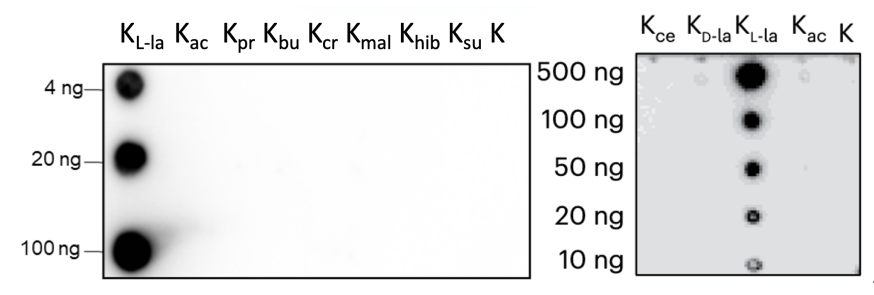
Figure: Performance demonstration of highly specific pan-antibodies for L-lactylation modification
L-lactylation is closely associated with L-lactate produced during glycolysis. L-lactate is the predominant lactylation substrate in humans and eukaryotes. Its metabolic pathway involves the conversion of pyruvate to L-lactate by lactate dehydrogenase A (LDH-A). Intracellular L-lactate can be further oxidized back to pyruvate and subsequently enter mitochondria for tricarboxylic acid cycle metabolism.
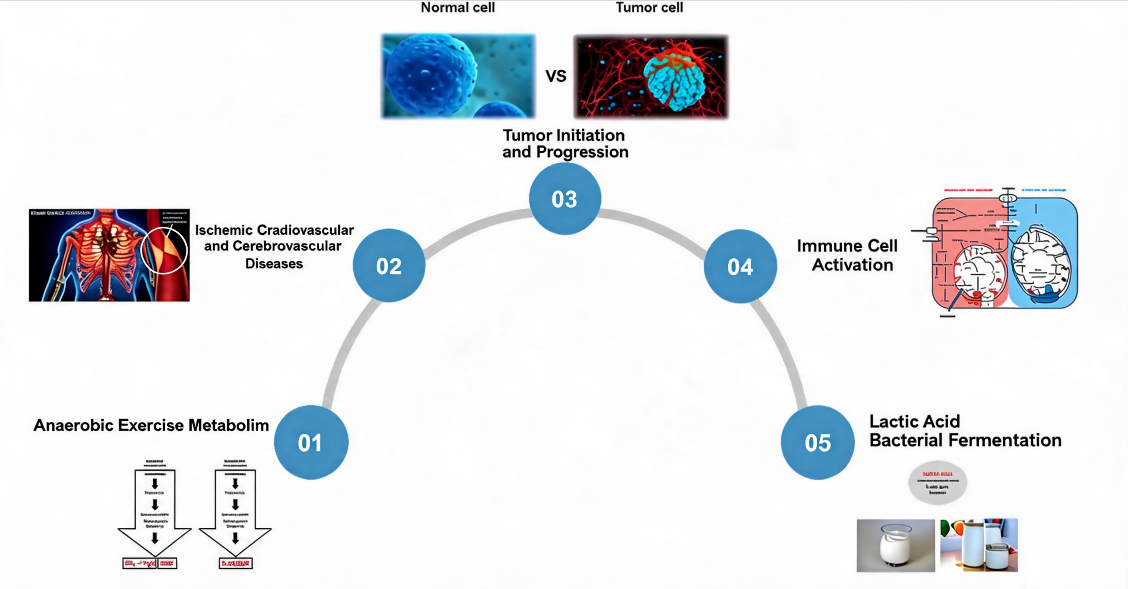
L-lactylation is the earliest discovered and most extensively studied form of lactylation. Recent evidence indicates that L-lactylation is a major responder to glycolysis and the Warburg effect in eukaryotes. It is widely distributed across tissues and organs and plays important roles in cancer, cardiovascular diseases, neurological disorders, and digestive system diseases. Research on L-lactylation provides new perspectives for disease diagnosis and therapeutic development.
1.Di Zhang, et al., 2019, Metabolic regulation of gene expression by histone lactylation. Nature.
2.Di Zhang, et al., 2024, Lysine L-lactylation is the dominant lactylation isomer induced by glycolysis. Nat Chem Biol.
3.Heyu Li. et al., 2024, AARS1 and AARS2 sense L-lactate to regulate cGAS as global lysine lactyltransferases. Nature.
1.Nature | Metabolic regulation of gene expression by histone lactylation | DOI: https://doi.org/10.1038/s41586-019-1678-1
2.Nature | NBS1 lactylation is required for efficient DNA repair and chemotherapy resistance | DOI: https://doi.org/10.1038/s41586-024-07620-9
3.Cell | Alanyl-tRNA synthetase, AARS1, is a lactate sensor and lactyltransferase that lactylates p53 and contributes to tumorigenesis | DOI: https://doi.org/10.1016/j.cell.2024.04.002
4.Cell | Metabolic regulation of homologous recombination repair by MRE11 lactylation | DOI: https://doi.org/10.1016/j.cell.2023.11.022
5.Cell Metabolism | Astrocytic LRP1 enables mitochondria transfer to neurons and mitigates brain ischemic stroke by suppressing ARF1 lactylation | DOI: https://doi.org/10.1016/j.cmet.2024.05.016
6.Cell Research | α-Myosin heavy chain lactylation maintains sarcomeric structure and function and alleviates the development of heart failure | DOI: https://doi.org/10.1038/s41422-023-00844-w
7.Nature Metabolism | Lactylome analysis suggests lactylation-dependent mechanisms of metabolic adaptation in hepatocellular carcinoma | DOI: https://doi.org/10.1038/s42255-022-00710-w
Interested in our services
Contact our experts to provide further information