



Interested in our services
Contact our experts to provide further information




In clinical research, blood is one of the most valuable sources of biological information. As the direct executors of biological activities and cellular functions, proteins represent a critical layer of information in blood-based studies.
However, blood proteomics remains highly challenging due to the complexity of plasma and serum samples. Key obstacles include the dominance of highly abundant proteins, an extremely wide dynamic range, and the complexity of protein species. In addition, sample quality, assay stability, data reliability, and detection depth are all critical factors that directly affect the quality of blood proteomics data.
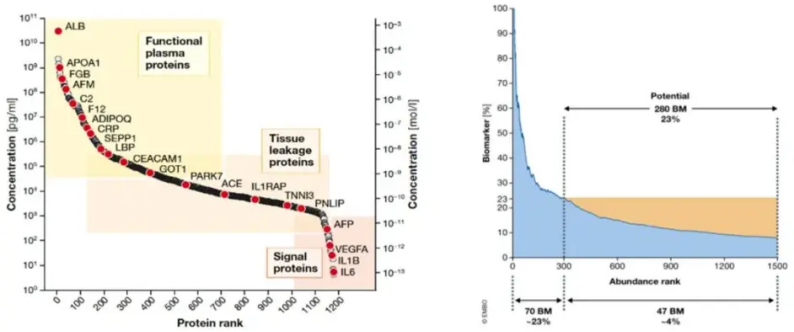
Figure 1. Left: concentration distribution and ranking of proteins in blood. Right: ranking distribution of biomarkers detected in blood.
After years of continuous technology development, PTM BIO has upgraded its blood proteomics platform and launched three magnetic bead-based Blood+DIA proteomics solutions:
Blood+DIA Proteomics: identifies 2,500+ proteins in plasma or serum
Blood+DIA Proteomics: identifies 4,000+ proteins in plasma or serum
Deep Insight Blood+DIA Proteomics: identifies 8,800+ proteins in plasma or serum
These breakthroughs overcome the limitations of conventional blood proteomics and open a new era of high-quality, Deep Insight blood proteome profiling.
PTM BIO’s magnetic bead-based Blood+DIA workflow reduces the dominance of high-abundance plasma proteins while enriching mid- and low-abundance proteins, enabling a more balanced and deeper blood proteome profile. This workflow is optimized for high-quality biomarker discovery and large-scale clinical cohort studies.
1.Proprietary ProteoMax™ NanobeadsImprove detection of mid- and low-abundance blood proteins.
2.Automated ProTeoMaster® PlatformEnhances throughput, consistency, and reproducibility for large-cohort studies.
3.10,000+ Protein Spectral LibrarySupports deeper and more accurate blood proteome identification.
4.Swiss-Prot-Based High-Confidence AnalysisReduces redundant identifications and improves data reliability.
5.Deep Insight Proteomics-Powered PerformanceDelivers higher throughput, faster analysis, and deeper proteome coverage.
1.Deep Plasma Proteome Coverage
PTM BIO’s Deep Insight Blood+DIA Proteomics enables identification of 8,000+ plasma proteins, providing high-value data for biomarker discovery, disease mechanism research, and therapeutic target exploration.
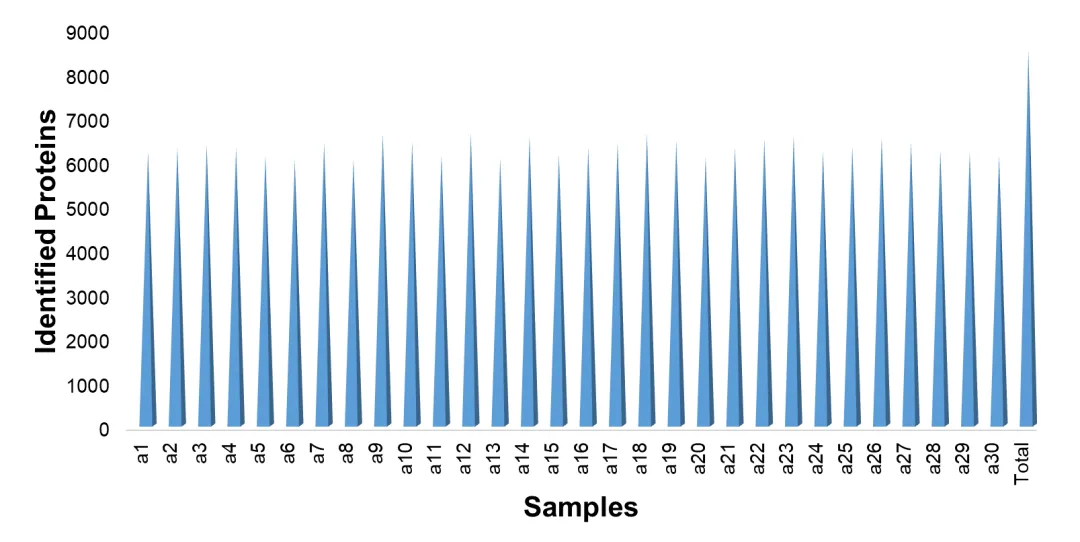
In internal validation, PTM BIO identified 8,487 proteins from 30 plasma samples across healthy and disease cohorts.
2.High-Quality, Reliable Data
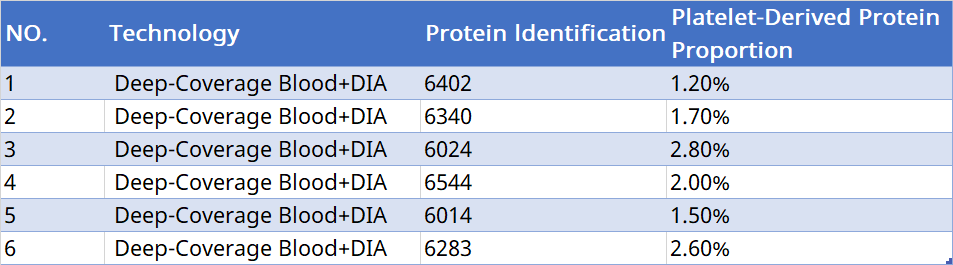
PTM BIO applies strict sample quality control to minimize the impact of platelet and cellular contamination. Internal validation showed that platelet-derived proteins accounted for less than 3%, supporting reliable downstream biological interpretation.
A carefully curated protein database containing 20,429 protein sequences further improves identification confidence and reduces interference from IgG variants and redundant protein fragments.
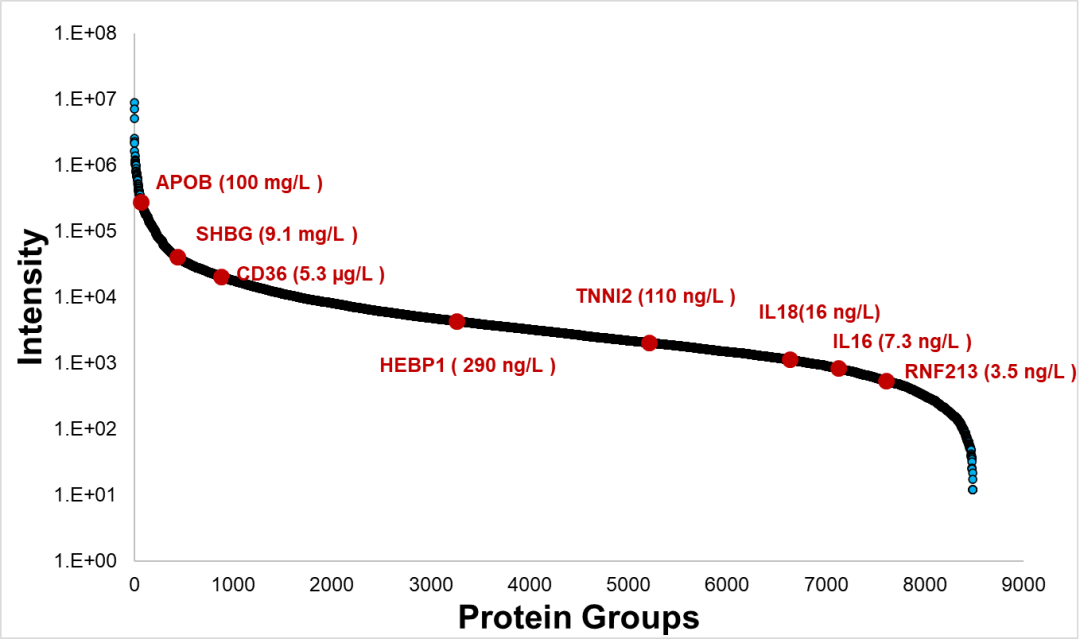
PTM BIO identified 8,487 plasma proteins, including 3,325 proteins matched to the HPPP database and 5,162 additional proteins beyond the HPPP reference set, demonstrating the strong discovery power of deep-coverage blood proteomics.
The platform captures proteins across a broad dynamic range, from high-abundance plasma proteins such as APOB to low-abundance cytokines and disease-relevant proteins such as IL18, IL16, and RNF213.
PTM BIO’s Blood+DIA proteomics enables high-throughput, reproducible analysis of large plasma and serum cohorts, supporting biomarker discovery, disease mechanism research, therapeutic target identification, and clinical translation.
PTM BIO’s Blood+DIA proteomics is particularly well suited for high-throughput and highly reproducible analysis of large-scale plasma or serum cohorts.
Combined with the curated Swiss-Prot database and advanced machine learning-based analysis, this platform provides a powerful tool for molecular mechanism discovery, blood biomarker screening, therapeutic target discovery, and clinical translational research.
1. Geyer PE, et al. 2017. Revisiting biomarker discovery byplasma proteomics. Mol Syst Biol.
2. Meier F, et al.2020. diaPASEF: parallel accumulation-serial fragmentation combined with data-independent acquisition. Nat Methods.
3. Ludwig C, et al. 2018. Data-independent acquisition-based SWATH-MS for quantitative proteomics: a tutorial. Mol Syst Biol.
4. Collins BC, Hunter CL, Liu Y, et al. Multi-laboratory assessment of reproducibility, qualitative and quantitative performance of SWATH-mass spectrometry. Nat Commun.
1.Cell | Multimodal clocks of human aging | DOI: https://doi.org/10.1016/j.cell.2026.04.025
2.Cell | A skin-hypothalamus axis couples heat stress and metabolic dysfunction | DOI: https://doi.org/10.1016/j.cell.2026.03.045
3.Nature | SPP1 is required for maintaining mesenchymal cell fate in pancreatic cancer | DOI: https://doi.org/10.1038/s41586-025-09574-y
4.Cell | Comprehensive human proteome profiles across a 50-year lifespan reveal aging trajectories and signatures | DOI: https://doi.org/10.1016/j.cell.2025.06.047
5.Cell | Systematic profiling reveals betaine as an exercise mimetic for geroprotection | DOI: https://doi.org/10.1016/j.cell.2025.06.001
6.Nature Metabolism | Maternal exercise prevents metabolic disorders in offspring mice through SERPINA3C | DOI: https://doi.org/10.1038/s42255-024-01213-6
7.Nature Aging | A geroprotective probiotic and its functional metabolite counteract inflammaging to extend healthspan | DOI: https://doi.org/10.1038/s43587-026-01181-4
8.Signal Transduction and Targeted Therapy | Combined FOLFOX4 with all-trans retinoic acid versus FOLFOX4 with placebo in treatment of advanced hepatocellular carcinoma with extrahepatic metastasis: a randomized, double-blind comparative study | DOI: https://doi.org/10.1038/s41392-023-01604-3
9.Nature Communications | VCL/ICAM-1 pathway is associated with lung inflammatory damage in SARS-CoV-2 Omicron infection | DOI: https://doi.org/10.1038/s41467-025-59145-y
10.Nature Communications | Self-anticoagulant sponge for whole blood auto-transfusion and its mechanism of coagulation factor inactivation | DOI: https://doi.org/10.1038/s41467-023-40646-7
11.Biomaterials | Design of NanoBiT-Nanobody-based FGL1 biosensors for early assisted diagnosis of esophageal cancer | DOI: https://doi.org/10.1016/j.biomaterials.2025.123286
12.Med | Determining a multimodal aging clock in a cohort of Chinese women | DOI: https://doi.org/10.1016/j.medj.2023.06.010
Interested in our services
Contact our experts to provide further information