



Interested in our services
Contact our experts to provide further information




O-glycosylation refers to the formation of an O-glycosidic bond between a glycan and the hydroxyl group of serine or threonine residues in proteins. Unlike N-glycosylation, O-glycosylation does not have a conserved consensus sequence or a fixed core glycan structure. Its glycan composition can range from a single monosaccharide, such as O-linked N-acetylglucosamine (O-GlcNAc), to complex polysaccharide structures, making O-glycosylation analysis more technically challenging than N-glycosylation analysis.
O-GlcNAcylation is a unique monosaccharide modification within the broader category of O-glycosylation. Increasing evidence shows that O-GlcNAcylation is closely involved in key biological processes, including development, cellular stress responses, transcriptional regulation, and signal transduction. It also plays important roles in major diseases such as cancer, cardiovascular disease, and diabetes, making it one of the most active areas in glycosylation research.
Mass spectrometry–based O-GlcNAc PTMomics provides a highly innovative and powerful approach for systematically profiling O-GlcNAc modification events and exploring their biological functions.
O-GlcNAc PTMomics uses specific antibodies to selectively enrich intact O-GlcNAc–modified glycopeptides. Because no deglycosylation step is required, the workflow enables simultaneous qualitative and quantitative analysis of both modification sites and glycoform information.
Compared with O-GlcNAc profiling, broader O-glycan PTMomics is more technically demanding because O-glycans are generally less abundant than N-glycans in cells. Therefore, O-glycan analysis often requires larger sample input. In addition, prior to enrichment of O-glycopeptides, PNGase treatment is used to remove N-glycans, reducing interference and improving O-glycopeptide enrichment efficiency.
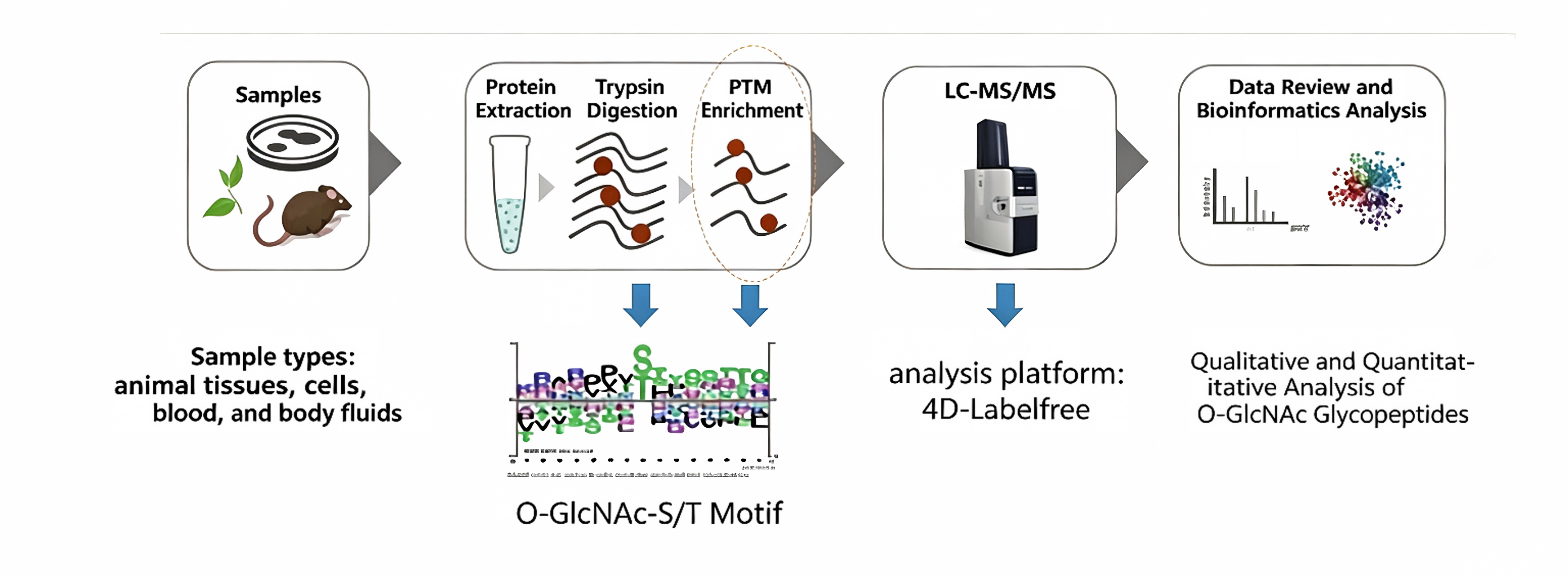
Complete Site-Specific Information
High-Sensitivity MS Detection
Clinically Validated Performance
In-Depth PTM Multi-Omics Analysis
1. Nature Communications:
O-GlcNAcylation of SIRT1 enhances its deacetylase activity and promotes cytoprotection under stress
In this study, O-GlcNAc PTMomics identified O-GlcNAcylation at S549 of SIRT1. This modification enhanced the deacetylase activity of SIRT1. O-GlcNAcylated SIRT1 promoted the deacetylation of key regulatory proteins such as p53 and FOXO3, thereby suppressing apoptosis and improving cell survival. These findings suggest that SIRT1 S549 O-GlcNAcylation may act as a molecular switch regulating the balance between cell survival and apoptosis.
2. Nature Communications:
O-GlcNAcylation of PGK1 coordinates glycolysis and TCA cycle to promote tumor growth
Using high-resolution mass spectrometry and biochemical validation, researchers identified O-GlcNAcylation at T255 of PGK1. This modification increased PGK1 enzymatic activity and enhanced glycolysis. In addition, PGK1 O-GlcNAcylation promoted mitochondrial translocation of PGK1, thereby suppressing TCA cycle metabolism. Together, these effects strengthened the Warburg effect and promoted tumor growth.
Interested in our services
Contact our experts to provide further information